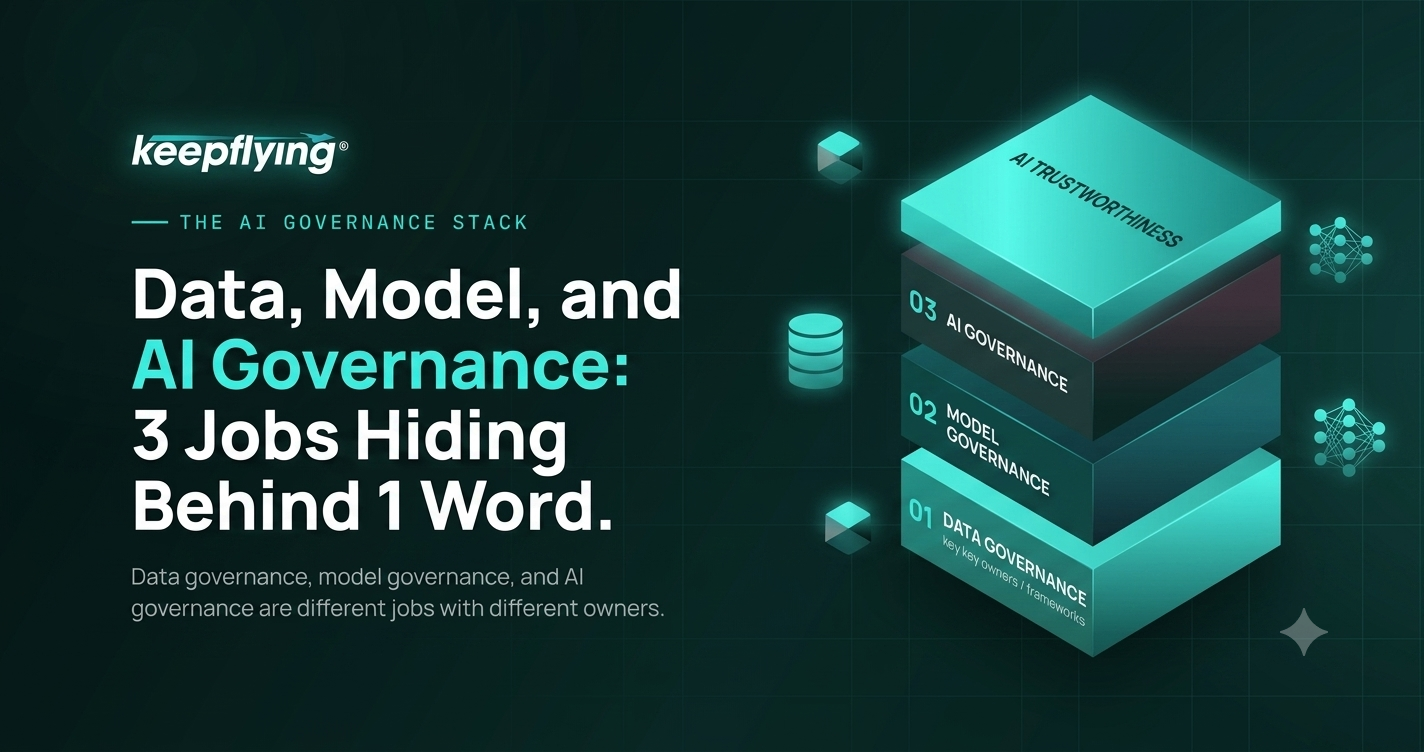
Data, Model and AI Governance: Three Jobs Hiding Behind One Word
Data governance, model governance and AI governance are different jobs with different owners. How the three layers connect, where guardrails fit, and why AI trustworthiness depends on all of them.
Governance in AI is three distinct disciplines that get collapsed into one word. Data governance controls the quality, security and accessibility of the data itself. Model governance controls the lifecycle and risk of the models built on that data. AI governance controls how the whole system affects decisions, people and compliance obligations. They stack: weak data governance starves the model layer, and weak model governance makes the AI layer unenforceable. Teams that treat them as one job usually end up doing none of them well.
We build AI for aviation, where every one of these layers eventually gets tested by an auditor, a lessor's lawyer or a regulator. Here is how we think about the three, and where guardrails actually fit.
Data governance: the layer that decides if anything above it works
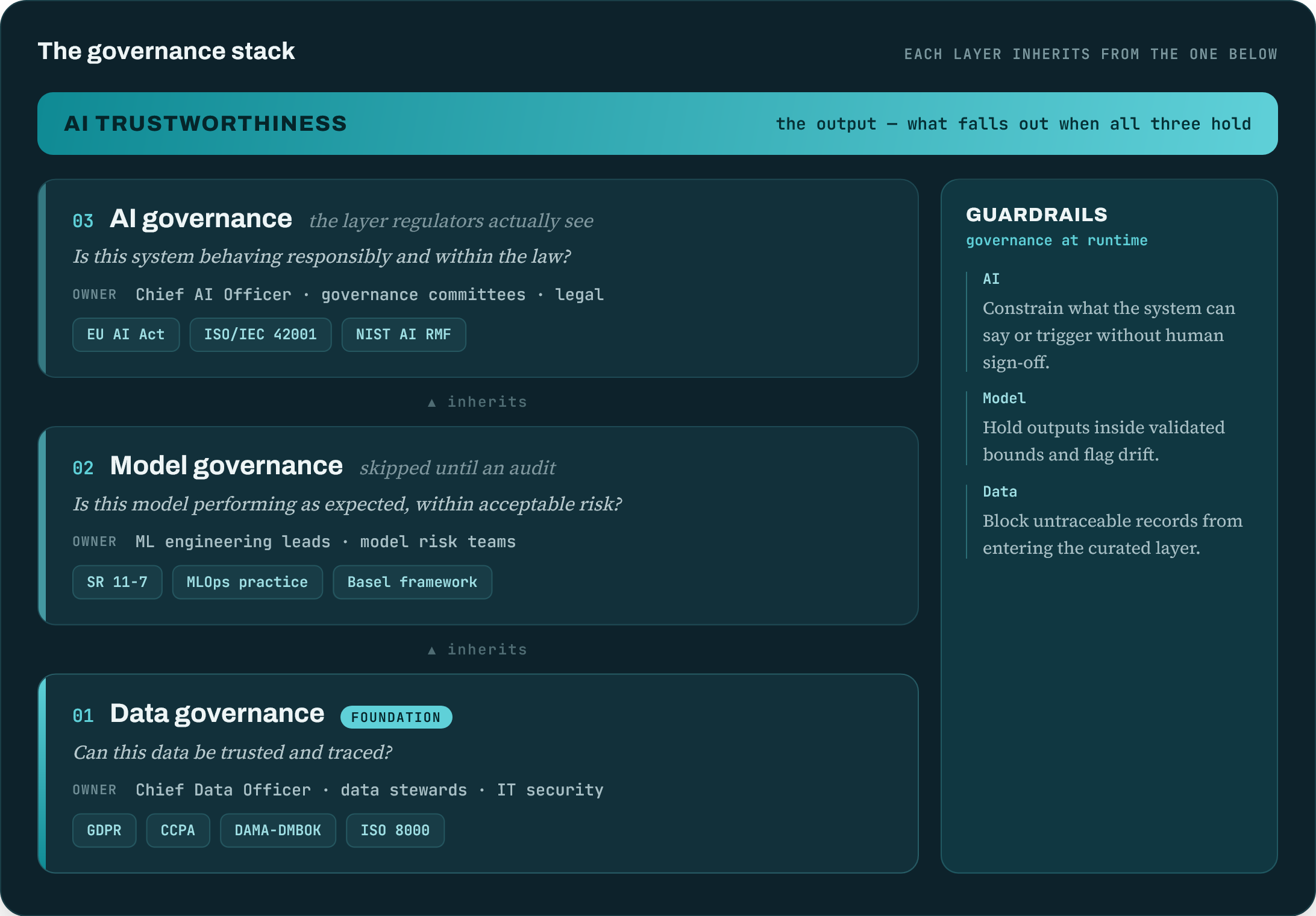
Data governance answers one question: can this data be trusted and traced? It covers quality standards, ownership, access control, privacy, metadata and lineage. The frameworks people reach for are GDPR and CCPA for privacy, DAMA-DMBOK for practice, ISO 8000 for quality. Ownership usually sits with a Chief Data Officer and data stewards.
That is the textbook version. The field version is less tidy. In aviation, data governance means knowing which scanned maintenance record backs which number, whose utilization report you are trusting, and who signed off when two sources disagreed. Our records work keeps confirming the same thing: most organizations govern their databases and ignore their documents, and the documents are where the risk lives.
If your AI readiness effort starts anywhere else, it is starting in the wrong place. Models do not fix bad data. They industrialize it.
Model governance: the layer everyone skips until an audit
Model governance answers: is this model performing as expected, and within acceptable risk? It covers versioning, testing before and after retraining, monitoring for drift and degradation, and documented validation. Banking got here first, which is why the canonical framework is the Fed's SR 11-7 model risk guidance. MLOps practice and the Basel framework fill in the rest. Ownership sits with ML engineering leads and model risk teams.
Two failure modes show up constantly. First, teams version their code but not their models, so nobody can say which model made last quarter's predictions. Second, models get validated once at deployment and never again, while the world drifts underneath them. We hold our shop visit forecasting to a published accuracy bar (85%+) precisely because a number you monitor is a number you can defend, and a number you stopped monitoring is a rumour.
AI governance: the layer regulators actually see
AI governance answers: is this system behaving responsibly and within the law? It covers risk classification, fairness and bias testing, transparency, explainability and human oversight. The frameworks are arriving fast: the EU AI Act, ISO/IEC 42001, the NIST AI Risk Management Framework. Ownership is moving up the org chart, toward Chief AI Officers, governance committees and legal.
This is the layer where "the model said so" stops being an answer. In our domain, an AI output that influences a lease decision or a redelivery position has to survive hostile review. That is why FinTwin is built so every answer traces to a source record, and why humans approve where judgement matters. Explainability is not a feature we added for the compliance slide. It is the reason customers in a regulated industry can use the product at all.
Where guardrails fit: governance at runtime
Guardrails are the enforcement arm of all three layers. Governance decides what should never happen; guardrails are the mechanisms that stop it happening at runtime. Data guardrails block untraceable records from entering the curated layer. Model guardrails hold outputs inside validated bounds and flag drift. AI guardrails constrain what the system can say or trigger without human sign-off.
The distinction matters because policy without enforcement is theatre. A governance document nobody can operationalize protects nothing. If you cannot point to the specific mechanism that stops a bad outcome, you have a wish, not a guardrail.
AI trustworthiness is the output, not a layer
AI trustworthiness is what falls out when the three layers and their guardrails hold. Trusted data, validated models, accountable systems. Miss any layer and trust fails in a predictable place: bad data produces confident nonsense, ungoverned models decay silently, ungoverned AI produces answers nobody is allowed to act on.
The practical sequencing, in our experience: govern the data first, because everything inherits from it. Stand up model governance the day your first model ships, not the day the audit lands. And treat AI governance as a design input, since retrofitting explainability into a system that was not built to trace its answers is close to a rebuild.
One thing we would push back on: the idea that this is a choice between the three. It is not a menu. The layers do different jobs, answer to different owners and fail in different ways. You build all three, in that order, sized to your risk.
FAQ
What is the difference between data governance, model governance and AI governance?
Data governance controls the quality, security, access and lineage of data. Model governance controls the lifecycle, performance and risk of ML models. AI governance controls the ethical, legal and organizational use of AI systems, including oversight and compliance. They are layered: each depends on the one below it.
What are guardrails in AI governance?
Guardrails are runtime enforcement mechanisms for governance policy: controls that block untrusted data, constrain model outputs to validated bounds, and require human approval for consequential actions. Governance defines the rules; guardrails make them physically hold in production.
Which frameworks apply to each governance layer?
Data governance: GDPR, CCPA, DAMA-DMBOK, ISO 8000. Model governance: SR 11-7, MLOps practice, the Basel framework. AI governance: the EU AI Act, ISO/IEC 42001, NIST AI RMF.
Who owns each layer?
Data governance typically sits with a Chief Data Officer, data stewards and IT security. Model governance with ML engineering leads and model risk teams. AI governance with Chief AI Officers, governance committees and legal or compliance.
How does governance relate to AI readiness?
AI readiness is the state governance produces: data that is collected, reconciled, validated and traceable, models that are versioned and monitored, and systems with human oversight where judgement matters. An organization can buy AI tools in a quarter. Readiness is built layer by layer, starting with the data.
KeepFlying builds FinTwin, the financial twin for aviation, where every answer traces to a source record and humans sign off where judgement matters. ISO 27001 certified since 2022. If you want a layer-by-layer view of your own readiness, ask us about the records maturity assessment.
Ready to Transform Your Aviation Operations?
Discover how our AI-driven solutions can optimize your maintenance operations and reduce costs.