Why 'Meaning' Is the Missing Layer in Aviation AI Accuracy
Aviation AI doesn't fail because it reads records wrong. It fails because it doesn't know what the records mean. Here's what an ontology fixes, and what skipping it costs.
Two AI systems read the same maintenance record. Both find the number. Only one of them knows what it means.
That gap isn't a model problem. It's a meaning problem, and it's the reason most "AI accuracy" complaints in aviation aren't really about accuracy at all.
What an ontology actually does
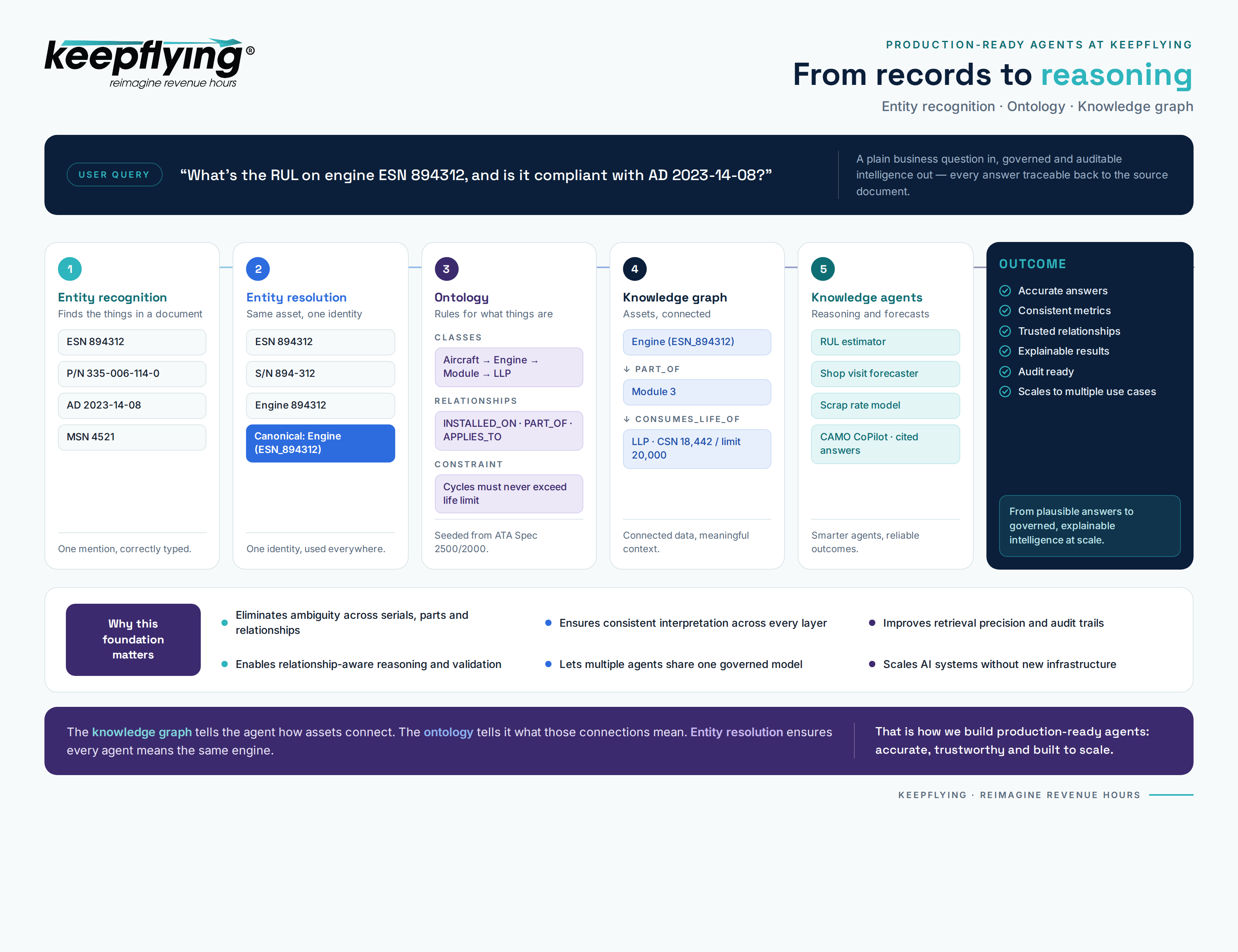
An ontology is a map of meaning. It tells a machine what things are and how they connect: that a part number isn't a string of characters, it's a component sitting on an assembly, with a life limit, tied to a contract someone signed years ago and still has to honor.
Strip that map away and an AI system is doing pattern matching on text and presenting it as an answer. Confidently. It read the words correctly. It just never learned what they meant.
Put the map back and every answer drags a chain behind it you can follow. This part sits on that assembly. The assembly has a life limit. The life limit is tied to an obligation that shows up on a balance sheet somewhere.
Where accuracy quietly breaks
Here's the failure mode that catches most teams off guard: the system can extract the exact right number and still hand you the wrong answer.
Take a life-limited part with a paper trail back to birth. A one-shot read pulls the figures off each certificate and moves on. Every page checks out. The extraction was correct.
What it missed is whether the pages agree with each other. A "date off" that falls before the "date on" of the same part on its next assembly isn't a typo, it's a physical impossibility, and it means somewhere in that chain a record is wrong. A system reading for meaning catches that contradiction and stops. A system reading for text alone has no way to notice, because nothing in the text itself looks broken.
That's the difference between an AI that reads documents and one that understands what they're documenting.
What skipping it costs
The market has already priced this gap. Fragmented, unreconciled technical records cost the industry an average of $800K in redelivery overrun per aircraft. Unoptimized workscopes, built without a clear model of what a part's remaining life is actually worth, leave roughly $250K in missed profitability on the table per engine overhaul.
Neither number is a technology failure. Both are a meaning failure; the data existed, and nothing in the system understood what it was looking at well enough to act on it correctly.
In most industries, a confidently wrong answer is an annoyance you correct and move past. In aviation, it's a grounded aircraft, a mispriced bid, or a redelivery that slips a month because a gap in the trace surfaced too late to fix cheaply. Accuracy here isn't a feature bolted on after the fact. It's the entire point of building the system at all.
The takeaway
Generic AI reads documents. The version worth trusting understands what's inside them, and it only gets there by being grounded in a map of what things actually are, not just what the page says.
If your team is running into "accuracy" problems that don't go away with better prompting or a bigger model, it's worth asking whether the real gap is meaning. That's usually where the fix lives.
Curious how this looks in practice? Get in touch with KeepFlying to learn more.
Ready to Transform Your Aviation Operations?
Discover how our AI-driven solutions can optimize your maintenance operations and reduce costs.