More Data Won't Fix Aviation's Prediction Problem. Physics Will.
Why prediction models for aircraft engines need engineering knowledge, not just scale, and what that means for forecasting cost and residual value you can defend.
There's a comfortable assumption running through aviation AI right now: that prediction is a data problem, and a data problem gets solved with scale. More historical records, bigger models, better prediction. It's a reasonable assumption if you're predicting the next word in a sentence. It's the wrong one if you're predicting what an aircraft engine will do.
Engines aren't datasets. They're physical systems.
An aircraft engine is a complex physical system operating under constantly changing conditions: ambient temperature, duty cycle, fuel quality, pilot handling, maintenance history, and dozens of other variables that interact with each other. Change one parameter and you don't get a proportional change in outcome. You get a different failure mode, a different deterioration curve, a different answer to "when does this need a shop visit."
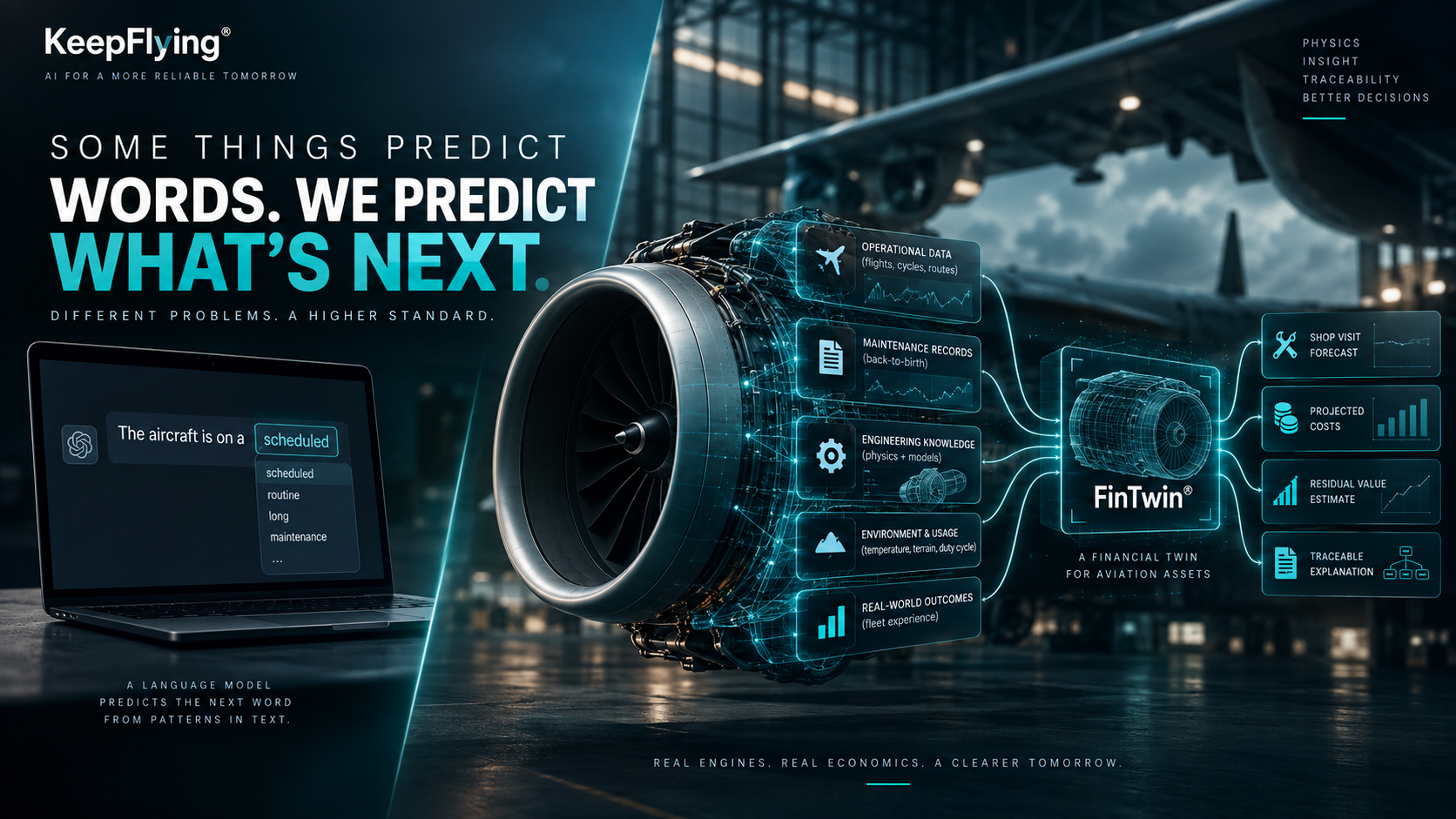
That's a different problem than the one large language models solve. A language model predicts the next token from patterns in text it has seen before. An engine health model has to predict a physical outcome from a system where the relationships between variables aren't fixed, and where the combination of parameters matters more than any single one of them.
New-generation engines make the gap harder to ignore.
The challenge is sharper on new-generation powerplants like the Pratt & Whitney GTF and CFM LEAP than it is on mature engines like the V2500 or CFM56. It isn't only that there's less operating history to learn from. It's that the parameters driving outcomes, and how they combine, are still being established, and they're moving targets. CFM secured FAA and EASA certification for the LEAP-1B's high-pressure turbine durability kit in July 2026, aimed at roughly doubling time on wing in hot and harsh environments, with fleet cutover expected in 2027. Pratt & Whitney's GTF Advantage completed EASA and FAA certification and is now certified on the A320neo family, entering service through 2026. Both engines will keep proving out their real-world reliability over the next several years of fleet introduction. A model trained on last year's parameter weightings will be wrong about next year's engine, not because it saw too little data, but because the physics of what matters is still shifting under it.
More data will help. Better models will help. Scale alone won't solve it.
The harder, more useful problem.
The interesting work is building models that understand the engineering relationships behind the data: how operating conditions, utilisation, environment, component history, and engine health interact, and how a change in one of those variables shifts the probability of a future event. That means moving past correlation and bringing physics, engineering knowledge, operational data, maintenance records, and real-world outcomes much closer together than a purely statistical model ever would.
Concretely, that looks like tracing an EGTM (exhaust gas temperature margin) trend against LLP (life-limited part) cycles and utilisation history, not just flagging that a number moved. It looks like knowing that a change in derate policy or a route with more thermal cycling changes the shape of the deterioration curve, not just the intercept. It looks like a back-to-birth record that isn't just a compliance artifact, but an input the model actually reasons over.
Why this matters beyond engineering.
This isn't only a technical distinction. A prediction that can't explain its own reasoning isn't one a CFO, an asset manager, or a noteholder can act on. If a model tells you an engine has an 80 percent chance of a shop visit within 18 months, the next question is always: based on what? A correlation over historical fleet data gives you a plausible-sounding number. A model built on the underlying engineering relationships gives you a number you can trace back to the parameters that produced it, and defend when someone asks why.
That traceability is the whole discipline behind building a Financial Twin, what we call FinTwin® at KeepFlying®, for an aviation asset: not a model that guesses well on average, but one where every projected cost, every residual value estimate, and every shop visit forecast can be traced back to the records and the engineering logic that produced it.
Sriram Haran, CEO, KeepFlying®
Ready to Transform Your Aviation Operations?
Discover how our AI-driven solutions can optimize your maintenance operations and reduce costs.